AI in the federal administration: What is permitted – and who is responsible?

The Swiss Federal Constitution states that the freedom of art is guaranteed. However, this does not mean that it operates in a legal vacuum, even if it may often feel that way. Artists and fashion companies, for example, must observe intellectual property, competition law, cultural property and data protection laws. Those who are unfamiliar with these issues can often find themselves on thin ice.
Registering a trademark or design is a basic requirement for protecting your intellectual property. Many mistakes can be made in the very formal application procedures. We find the right strategies, take care of the applications and accompany you through the rest of the process.
We have decades of experience in the defence of intellectual property rights. We enforce claims for our clients in the event of infringement of trade mark and other intellectual property rights.
Many agreements in the creative industry are made more informally than in other business areas. We help to regulate contractual relationships in a clear and legally compliant manner – from the model release to the general terms and conditions.
If you want to commercialise intellectual property rights, there is no getting around cooperation with third parties. We advise and support you when IP rights are to be transferred or licenced. We look for the best utilisation options for you.
Artists and fashion designers have to observe extensive compliance regulations, from textile labelling and supply chain tracking to money laundering. We help you keep an overview.
If you are not taking care of your trade marks, you are weakening yourself. The registration of similar or identical trade marks by third parties dilutes your own trade mark rights. Regular monitoring of the registers counteracts this. In most cases, collisions can be easily avoided. We offer monitoring services.
Founding a company without first searching for relevant prior rights of third parties can have unpleasant consequences. There is a risk of losing all your investment in brand development. We search for prior rights and carry out risk analyses – even before registration.
Artists must respect the personal rights of others. This includes the right to one’s own image and the FADP. Data protection regulations must also be observed when processing contracts.
We prepare legal opinions on all issues relating to intellectual property, competition law, distribution law and examine business concepts for feasibility.
Checklists and overviews on the implementation of NIS 2.
An AI policy alone does not constitute governance. It is crucial that organisations know which AI systems are being used, who decides on their deployment, which risks are accepted, and how procurement, operation, monitoring and escalation are embedded within the organisation. The training course provides a practical governance model for organisations wishing to scale AI in a controlled manner.
Artificial intelligence is often put to productive use within organisations more quickly than legal, contractual and organisational safeguards can be put in place. This training course demonstrates how specific AI use cases can be structured, assessed on a risk-based basis, approved and monitored from the initial idea through to live operation – with a focus on Swiss law and relevant EU considerations.
Switzerland intends to fundamentally overhaul its cyber regulation. A standalone cyber security law is set to cover manufacturers of digital products as well as operators of critical infrastructure, hosting providers and cloud service providers. For businesses, this is not just a matter of new IT security requirements: product development, management, legal and compliance functions are also likely to be affected. This may provide greater clarity – but at the same time risks creating new overlaps. The key factor will be whether the legislator succeeds in reconciling European standards, effective cyber security and workable compliance.
AI training data, the Digital Omnibus, the protection of children’s biometric data and freedom of assembly are the focus of episode 191.
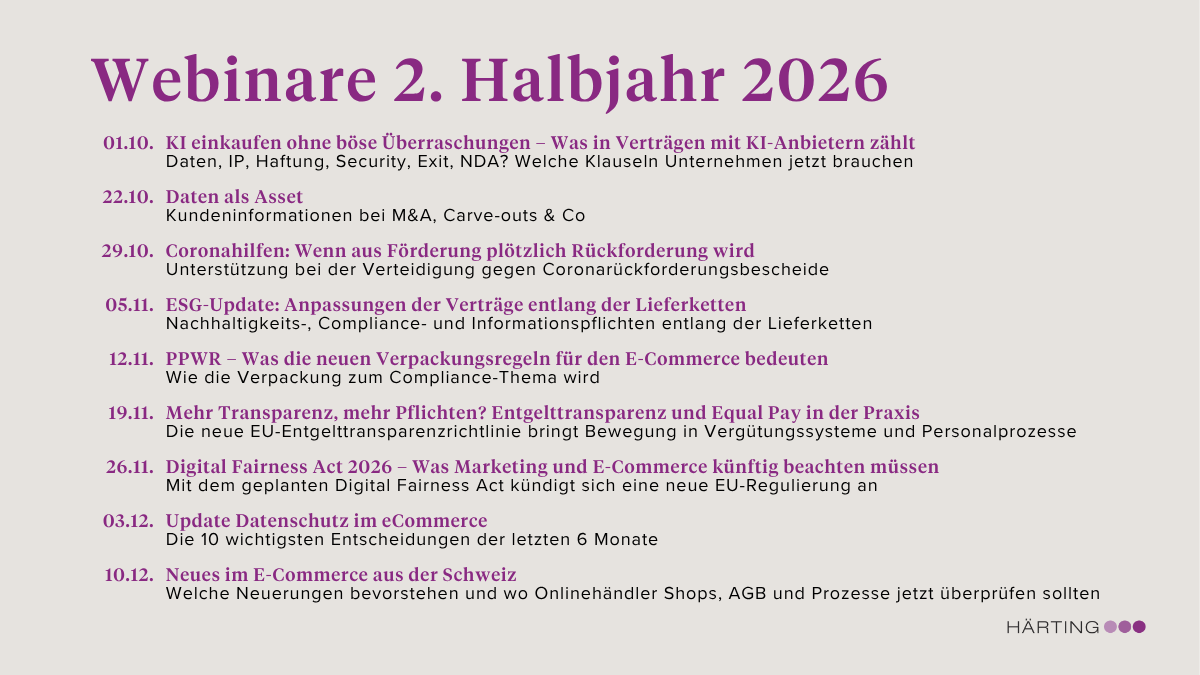
Every Thursday, 10 am–11 am. Register now for free! If you have any questions or suggestions, please feel free to send a message to friedrich@haerting.de. Are you also looking for external webinars and events? You can find these under ‘Events’.
Cameras, radar sensors and AI can detect falls and alert care staff. However, when technical assistance is used in bedrooms, patient rooms or other private areas, the stakes are particularly high. The EDÖB and privatim set out the limits imposed by data protection law in a new guide. For hospitals and care homes, this means above all that surveillance must not become standard practice – and data protection must be taken into account right from the stage of procuring the technology.
Smartwatches have long been part of everyday life in the office. Smart glasses now represent a new generation of wearables that carry cameras, microphones and AI functions directly on the body. This creates new risks for organisations: confidential conversations can be recorded, people can be filmed without their knowledge, and data can be transferred to external clouds. The FDPIC warns of the data protection risks posed by wearables. Organisations should therefore check whether their existing data protection and IT policies are still adequate.
The EU is significantly expanding the information requirements regarding warranty rights and guarantees in the retail sector. From 27 September 2026, online and high-street retailers must use standardised model notices (‘harmonised notice’ and – under strict conditions – a guarantee label).