





















































































Follow the Rule of Law, Episode 169
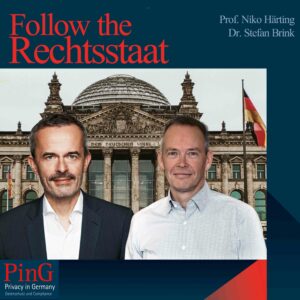
The latest podcast with Stefan Brink and Niko Härting focuses mainly on frustrating issues. First, we discuss (00:47) the vexing ruling by the Administrative Court of Karlsruhe (3rd Chamber) of 18 March 2026 (Case No. 3 K 2355/24), which dismissed the claim for access to documents from a technical consultation between the Federal Constitutional Court and judges of the European Court of Human Rights in June 2023. Although the issue concerned freedom of information, the Federal Constitutional Court did not wish to demonstrate transparency. The Administrative Court of Karlsruhe ruled that whilst this exchange between courts should not be classified as case law and was therefore subject to freedom of information, priority should be given to protecting the confidentiality of exchanges between courts over the required transparency of administrative actions. This is difficult to comprehend. Next (18:29) is a late concession by the ‘House of History’ regarding the Schabowski note: the House of History did not wish to provide any details regarding the acquisition of the historic note on the opening of the Wall and sought to draw a veil of silence over who had received €25,000 for it. After the Cologne Administrative Court and the Higher Administrative Court of North Rhine-Westphalia had upheld a reporter’s claim, the museum decided against taking the case to the Federal Administrative Court and revealed what it would rather have kept secret: the (tax) money went to the circle of the shady GDR currency procurer, Schalck-Golodkowski. Really annoying. Incidentally, the legal costs are also borne by the taxpayer. Next (27:09) we look at a ruling by the ECJ (dated 19 March 2026 – C 526/24) on the right to information: in March 2023, a person residing in Austria subscribed to the newsletter of a family-run optician’s firm based in Arnsberg. In doing so, they entered their personal data into the registration form on the company’s website and consented to the processing of this data. Thirteen days later, the data subject submitted a request for access under Article 15 of the GDPR to the optician, who rejected the request as abusive. The data subject pursued his request for access and also asserted a claim for damages under Article 82 of the GDPR in the amount of €1,000. An vexatious case. Following a referral from the German Local Court, the ECJ has now clarified: Even an initial request for access to personal data under Article 15 of the GDPR, made by the data subject to the controller, may be regarded as ‘excessive’ within the meaning of Article 12(5) of the GDPR if the controller demonstrates that the request was not made to ascertain the processing of such data and to verify its lawfulness, but rather with an abusive intent. Finally (38:00), the focus is on a decision by the Dresden Administrative Court (5 November 2025, case number: 6 K 790/23), which once again concerns the documentation of a parking offence by means of a photograph. The Saxony Data Protection Supervisory Authority informed the photographer in a letter of its legal opinion that reporting via photograph was only permitted in cases of legitimate interest due to personal involvement (contrary to the Ansbach Administrative Court) and announced sanctions in the event of a repeat offence. The Dresden Administrative Court deemed the action brought against this to be inadmissible, ruling that the warning was not an administrative act and that actions for annulment and for performance were inadmissible. Furthermore, Article 78 of the GDPR grants a right of appeal against supervisory authorities only in the case of legally binding decisions. Annoying.